
◆ ESSAY


Regulatory status and legislative trends for KRW stablecoins
In Korea, the private-sector issuance of stablecoins pegged to the value of the won is effectively prohibited.
- Opposes the issuance of KRW stablecoins by non-bank institutions
- Made enactment a national policy task, and as of June 2025 the opposition party has taken the lead in proposing a bill
📎 0611_Framework Act on Digital Assets (Rep. Min Byeong-deok).pdf (447 KB)
📎 0728_Act on Payment Innovation Using Value-Fixed Digital Assets (Rep. Kim Eun-hye).pdf (169 KB)
| Item | Framework Act on Digital Assets | Act on the Issuance and Distribution of Value-Stable Digital Assets | Value-Fixed Digital Asset Act | Value-Stable Digital Asset Issuance Business Act |
|---|---|---|---|---|
| Proposal | Rep. Min Byeong-deok(Democratic Party of Korea) - Proposed 2025.6.10 | Rep. Ahn Do-geol(Democratic Party of Korea) - Proposed 2025.7.28 | Rep. Kim Eun-hye(People Power Party) - Proposed 2025.7.28 | Rep. Kim Hyun-jung(Democratic Party of Korea) - Proposed 2025.8.21 |
| Nature of the bill (enactment/framework act, etc.) | Framework act - A framework act covering digital assets as a whole (*stablecoins are only part of its content) | Standalone enactment - A special act for the regulation of stablecoin issuance and distribution | Standalone enactment - A special act aimed at payment settlement innovation for stablecoins | Standalone enactment - A comprehensive regulation of stablecoins and user protection act |
| Scope of application | - A basic regulatory framework for all digital assets - As one of these, includes provisions permitting and managing the issuance and distribution of asset-linked digital assets (stablecoins) | - The full range of matters concerning the issuance and distribution of won-based stablecoins (excluding those linked to other assets, algorithmic types, etc.) - Targets domestically circulating won-linked stablecoins | - The full range of issuance, use, and related conduct of stablecoins linked to legal tender such as the won - Excludes other virtual assets and is limited to value-fixed digital assets (stablecoins) | - Brings all stablecoins circulating domestically (including both domestically issued and foreign-issued) into the regulatory system - A comprehensive act spanning from issuance-business licensing to a protection fund at the distribution stage |
| Key definitions | - Asset-linked digital asset: a digital asset issued in linkage to the value of a specific underlying asset (an umbrella term for stablecoins) - Issuer: a corporation licensed by the FSC - User: digital asset users in general | - Value-stable digital asset: an electronic representation whose value is stabilized by being linked to the value of a specific asset - Issuer: a licensed issuing operator - User: a stablecoin holder (able to claim redemption) | - Value-fixed digital asset: defined as a digital asset that seeks value stability by being linked to the value of a specific asset such as legal tender - Issuer: a licensed issuing operator - User: a stablecoin holder (able to claim redemption) | - Value-stable digital asset: a digital asset that stabilizes its value by being linked to real assets such as legal tender - Issuer: a licensed issuing operator - User: a holder of the issued stablecoin |
| Competent authority and supervisory framework | - Centered on the Financial Services Commission (FSC) - Establishment of a Digital Asset Committee under the direct control of the President - Relevant agencies may participate in the Digital Asset Committee - Concurrent introduction of a market self-regulatory organization (Digital Asset Industry Association) | - Financial Services Commission (FSC) + consultative body - The FSC handles licensing and inspection - Establishment of a Digital Asset Committee with participation from the Ministry of Economy and Finance and the Bank of Korea (BOK), among others - Multi-agency joint supervision from a financial-stability standpoint | - Supervision by the Financial Services Commission (FSC) alone (prefers a streamlined supervisory framework) - Through an issuer registration system, the FSC oversees licensing, cancellation, etc. - The Bank of Korea (BOK) has the authority to request data submission and inspection opinions under monetary and credit policy (no separate consultative body is established; the BOK is directly involved) | - The Financial Services Commission (FSC) is the competent ministry - Authority over issuance-business licensing and supervision - The Bank of Korea and others are not given a direct supervisory role in the bill (though the possibility of consultation to consider monetary-policy impact is mentioned) - The user protection fund is managed by the FSC |
| Issuer licensing system and requirements | Introduces a licensing system - FSC issuance-business license required Licensing requirements - Equity capital of KRW 500 million or more Eligible applicants - Domestic corporations (startups such as fintechs may also enter), meeting soundness requirements - Issuance permitted not only for banks but also for non-financial companies | Introduces a licensing system - FSC issuance-business license required Licensing requirements - Equity capital of KRW 5 billion or more - Information-security specialists and an internal control system are mandatory - Requirements are effectively designed around financial companies such as banks Eligible applicants - Domestic stock corporations and financial institutions, or foreign corporations with a domestic branch (this means foreign companies can also apply for a license if they have a domestic branch) | Introduces a licensing system - FSC issuance-business license required Licensing requirements - Equity capital of KRW 5 billion or more - Securing an appropriate internal control and security system, etc. Eligible applicants - Both domestic corporations and foreign corporations with a domestic place of business are allowed. The issuing entity is not specifically limited to banks; non-financial companies may also register if they meet the requirements | Introduces a licensing system - FSC issuance-business license required Licensing requirements - Equity capital of KRW 5 billion or more - A sound business plan and meeting the prescribed human and physical requirements Eligible applicants - Not limited to financial institutions such as banks; non-financial companies are also allowed (any domestic corporation that meets the requirements) |
| Reserve asset requirements and management | Obligation to maintain backing assets of 100% or more of the issued amount - Asset composition: centered on safe assets, to be determined by subordinate regulations - Bankruptcy-remoteness measures applied to reserve assets - Details such as separate trust management and disclosure are delegated to the enforcement decree | Obligation to maintain backing assets of 100% or more of the issued amount - Asset composition: liquid assets such as cash, demand deposits, and government and municipal bonds with maturities ≤1 year - Reserve assets must be held separately through a custodian (trust, etc.) with a bankruptcy-remoteness obligation - In the event of the issuer's insolvency, reserve assets are used to repay users on a priority basis | Obligation to maintain backing assets of 100% or more of the issued amount - Asset composition: may be held not only in cash, bank deposits, and government and public bonds but also in private bonds (≤1 year), etc. (relaxed) - Reserve assets must be managed separately, such as in trust, and segregated from the issuer's assets with a bankruptcy-remoteness obligation | Obligation to maintain backing assets of 100% or more of the issued amount - Asset composition: short-maturity, high-quality financial instruments such as cash, government bonds, municipal bonds, special bonds, and MMFs - Obligation to hold separately from the issuer's assets and a trust/bankruptcy-remoteness obligation - Even if the issuer goes bankrupt, users' priority right of repayment over the reserve assets is specified |
| Disclosure obligations | Includes mandatory disclosure and the introduction of a system for reviewing disclosure content (at the framework-act level) - Introduction of disclosure verification through a self-regulatory organization | Obligation of white paper disclosure and periodic disclosure - Obligation to submit and publicly disclose a product prospectus including the total issuance limit, reserve asset composition, redemption method, etc. - Obligation to disclose reserve asset details monthly and report periodic accounting audits - Provision for liability for damages if the white paper or disclosure materials contain false content | Obligation of white paper disclosure - A product prospectus (including the issuer, business plan, technology, reserve assets, redemption method, etc.) must be submitted and disclosed within 3 days - However, a periodic disclosure obligation is not specified - Provision for civil liability for damages when statements are false | No specific mention - Possibility of requiring a white paper or prospectus for user protection (no specific disclosure content mentioned) |
| Redemption obligations and user protection measures | Guarantees user rights through redemption obligations and reserve asset management - Framework-act-level provisions such as support for digital asset damage relief - Detailed provisions for protecting stablecoin holders are delegated to a later enforcement decree | Obligation to redeem in won within 3 business days of a redemption request - Provision for sanctions in the event of failure to fulfill the redemption obligation - All interest payments completely prohibited - Provisions for civil remedies such as damages when the white paper is false - Prevention of misuse of user assets through strengthened internal controls. | Obligation to redeem in won within 10 business days of a redemption request - Emphasizes guaranteeing fulfillment of the redemption obligation to users - Interest payment permitted - No separate user protection fund or insurance provision | Provision for immediate redemption - Legislates a priority right of repayment for users in the event of the issuer's bankruptcy - Introduction of a protection fund for foreign-issued stablecoins - Reserves accumulated in proportion to the quantity of foreign coins held by domestic exchanges |
| Regulation of foreign-issued assets | - For foreign-issued general digital assets, specifies only the regulatory principles (scope of domestic user protection, etc.) - Does not establish separate provisions for stablecoins | - Foreign-issued stablecoins are not directly licensed - Listing is left to the listing-eligibility review of domestic VASPs (exchanges) - That is, when supporting trading, each individual exchange conducts risk assessment and disclosure to protect users - There are no separate central-level registration or licensing provisions | - Foreign-issued stablecoins are also recognized as domestic value-fixed digital assets if they meet certain requirements and register with the FSC - That is, official distribution of foreign stablecoins is permitted (if domestic standards are met) | - Registration with the FSC is required to circulate domestically - In addition, an obligation to accumulate a protection fund is imposed to protect domestic users - When a domestic exchange handles foreign coins, it must reserve a certain amount - Through this, Tether (USDT), USDC, and others are also brought within the regulatory scope |
| Sanctions for violations | - Comprehensive sanction provisions apply under the framework-act system - Penalties for unlicensed business and fraudulent conduct - The supervisory authority may issue corrective orders and revoke business licenses - Detailed penalties are provided at the level of applying other financial laws by analogy | - Promising or paying interest is illegal and subject to criminal punishment - Penalty provisions for unlicensed business and violations of reserve asset requirements - Provision for liability for damages when users are harmed by false white paper disclosure, etc. (includes penalty surcharge and administrative fine provisions) | - Sanction provisions such as criminal punishment and business suspension for unregistered issuance - Imposition of administrative fines, criminal fines, etc. for non-compliance with reserve assets and for misconduct - Since interest payment is permitted, there are no related punishment provisions | - Strong sanctions such as imprisonment or fines for unlicensed issuance or misconduct - Imposition of administrative fines, etc. for violations of reserve requirements and reporting obligations - Includes sanction provisions against exchanges for handling unregistered foreign coins |
| Other notable features | Comprehensive framework act - A comprehensive act encompassing the entire digital asset industry - KRW 500 million entry barrier: the lowest entry barrier compared with the other bills → easy for startups to participate - Digital Asset Committee: a policy-coordination body under the direct control of the President, pursuing both market promotion and investor protection - Introduction of self-regulation: legislates the role of an industry self-regulatory organization | - Complete prohibition of interest payments: interest, discounts, rewards, and any other pretext are deemed interest and prohibited (so that stablecoins function as currency-purpose assets rather than investment products) - Financial stability first: designed to consider monetary policy and to prevent the erosion of bank deposits - Strengthened internal controls: controls issuers at the level of financial companies, e.g., requiring dedicated personnel - Cooperation among the FSC, MOEF, and BOK: establishment of a consultative body of relevant agencies | - Interest payment permitted: no prohibition provision → interest can be offered on stablecoins (deposit-like services may also be possible in the future) - Innovation-oriented stance: focuses on industry activation and competitiveness rather than regulation - Negative regulation: grants flexibility by delegating detailed requirements to the enforcement decree, etc. | - The first legislation comprehensively covering stablecoin issuance and distribution - Lessons from the Terra-Luna incident: strengthens protective safeguards (priority repayment, protection fund, etc.) against issuer insolvency - Regarding interest payments: the bill mentions no explicit prohibition provision, with the practical possibility that payment is permitted - Mandates registration with the FSC when foreign-issued stablecoins are distributed domestically |
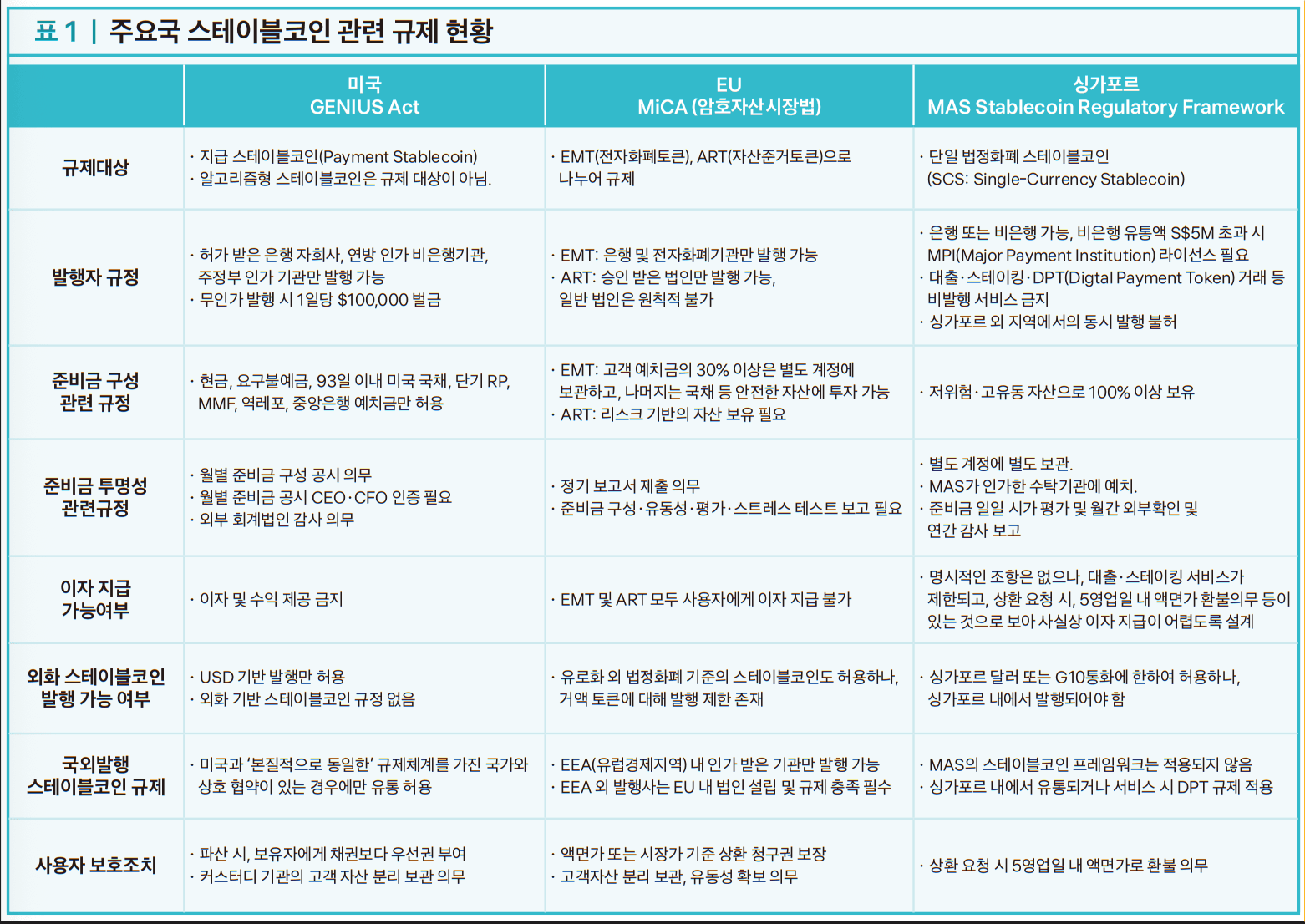
Source: Toss Insight - Stablecoin Report

KRW stablecoins likely split distribution, infrastructure and issuance three ways. Trades clear off-chain, settle on-chain, so the Layer-1 opening is stage-two expansion.
Stripe and Circle building their own L1s is a bet on owning the financial ledger itself. It could bring millions on-chain, but also revive Web2 walled gardens in Web3.